
The Lake District’s Roman past
Did you know that the Lake District is steeped in thousands of years of human history, dating back as far as prehistory? From an ancient bathhouse to a prehistoric settlement, the marks of our ancestors are all around us. You can discover more at the Lake District Annual Archaeology Conference on 8 October, but for now, read on for a fascinating history lesson!


 We hope you feel inspired to dig deep and discover the rich and varied history of our wonderful corner of the world – it’s closer than we might sometimes realise.
1900 Years of Hadrian’s Wall
Across parts of our spectacular landscape stretches Hadrian’s Wall, a barricade which guarded the wild and windswept northern frontier of the Roman Empire. It remains a symbol of the power and reach of the Roman Empire, and of the vibrant and multi-cultural society it served. This year, Hadrian’s Wall 1900 Festival is celebrating the 1900th anniversary of its construction. From Hadrian’s birthday on 24 January, through to the Roman festival of Saturnalia on 23 December, the festival will involve local people and organisations to support a programme of events and activities. From Wallsend to Ravenglass, the festival will help everyone to connect with their cultural past and heritage.Over the summer, we’ve been busy excavating
Stretching across the fells between Ambleside and Brougham is England’s highest Roman road – the 2000 year-old High Street Roman road. Used by our Roman predecessors to link their forts at Brougham and Ambleside, it is believed to date back to prehistoric times. As you walk along, you can see traces of these Roman settlers in kerb stones and patches of metalling. You might remember that in August, as part of the Our Upland Commons project, we were lucky enough to join volunteer and professional archaeologists at a dig on this extraordinary site.
What have we found?
- Using geophysical surveys and archaeological excavation, they wanted to uncover new information about the Roman archaeology and landscape development of the area.
- A trench excavated on the summit of Wether Hill supported theories of the trackway’s prehistoric past. It may have been used by the Romans later on, and historically it’s been modified and used by many different people for many different purposes.
- The trackway epitomises our rich, layered and diverse history.
Meanwhile, at Ravenglass Bath House
The Ravenglass Bath House Open Days saw visitors immerse themselves in the history of one of the best-preserved Roman military bathhouses in Britain.Guided tours showed visitors around the site
- Two rooms with surviving doorways and windows
- Other excavated rooms which include plumbing for hot and cold baths
- The traces of an adjacent fort – a major Roman naval base and regional supply point
We’re also home to other significant sites
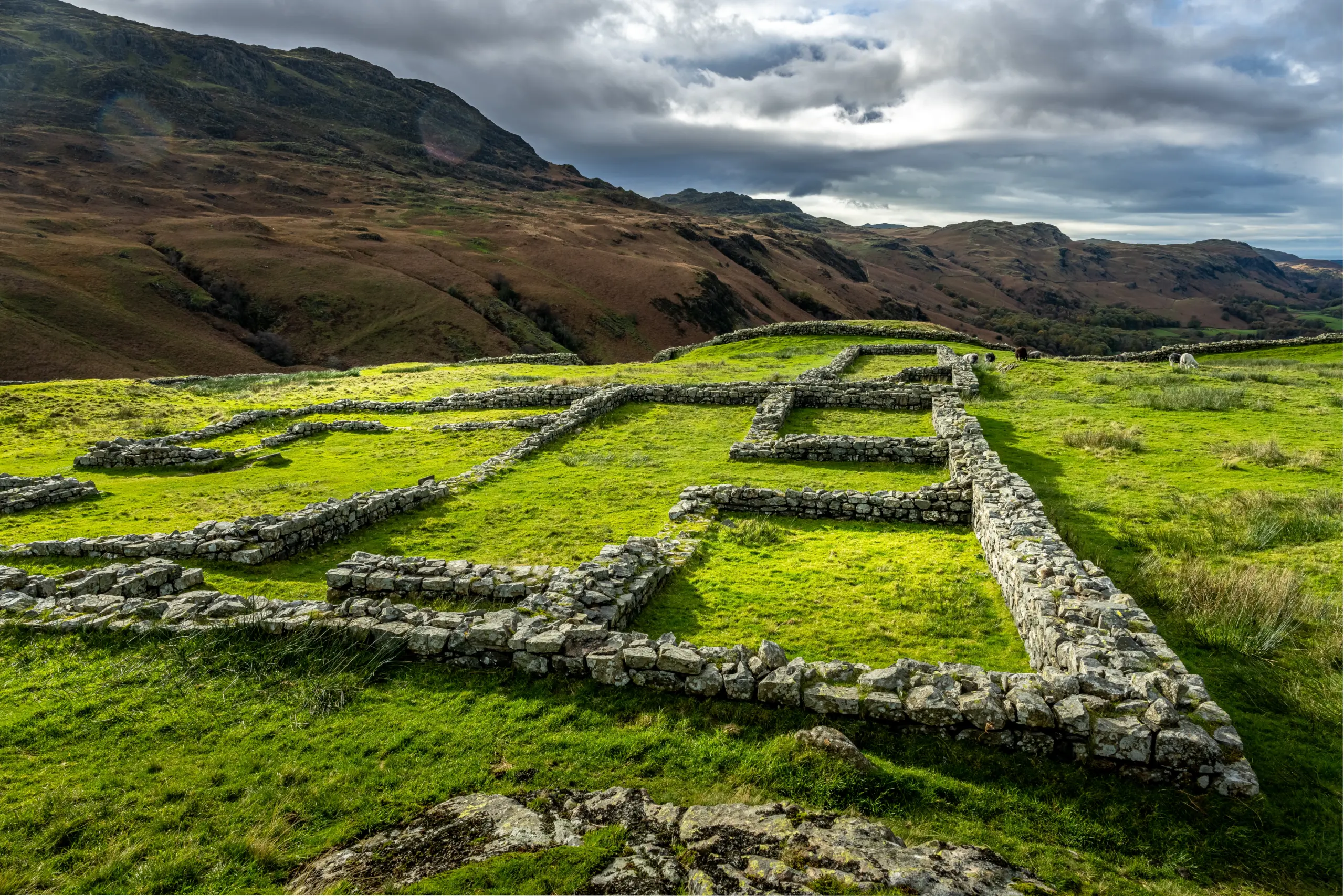
- Hardknott Roman fort, a rocky outpost of the Roman Empire, built during Hadrian’s reign. The ruins are amazingly well-preserved, and you can see the traces of barracks, a commandant’s house, a parade ground and a bath-house.
- The foundations of a headquarters building in Ambleside, along with the commandant's house, granaries, gates and defences.
- At the Barnscar Romano-British Farmstead near Ravenglass, you’ll find remains of an earlier British settlement. There are at least six round houses, three large enclosures for livestock, field boundaries and a trackway.
- The Aughertree Fell settlement, where three farmsteads reflect an older, local way of life. Hut circles and animal pens, parallel banks and a ditch create a sense that the original settlers and their new Roman neighbours were working out a way to live in harmony.
We hope you feel inspired to dig deep and discover the rich and varied history of our wonderful corner of the world – it’s closer than we might sometimes realise.