


What's on this page
LDNPA actions include:
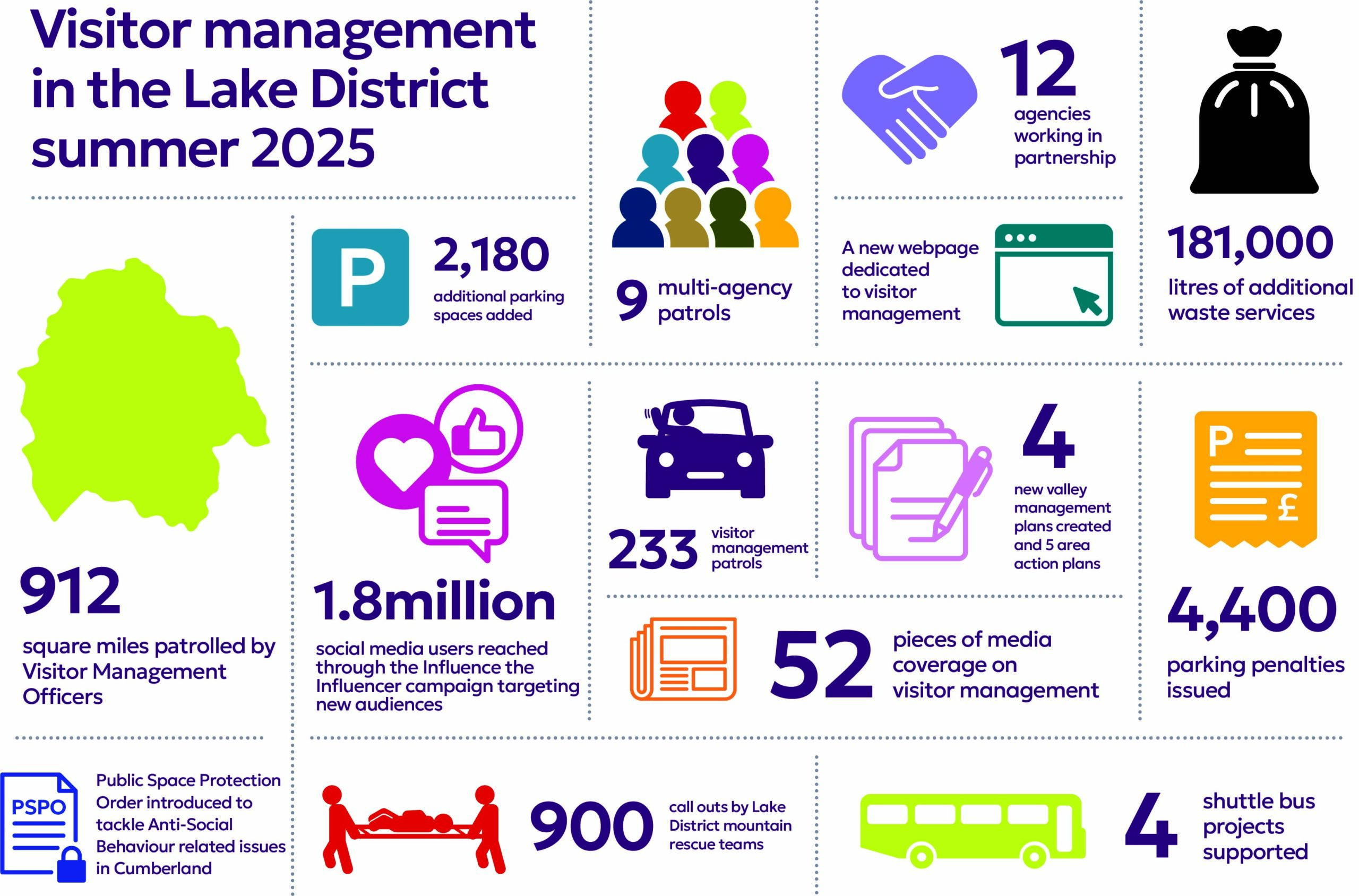
- Leading the Strategic Visitor Management Group (SVMG): a collective of authority decision makers, such as major landowners (National Trust, Forestry England and United Utilities), Cumberland and Westmorland and Furness Councils, highways, police, mountain rescue, fire and rescue services and business groups (Enterprising Cumbria, Cumbria Tourism).
- SVMG proactively addresses issues through a range of initiatives, such as overflow car parks, shuttlebuses, extra bins, community litter pickers and social media campaigns.
- SVMG Patrols: we organise regular patrols throughout the high season to speak to and educate fly campers and irresponsible parkers. We are joined by a range of agencies, including police, fire, landowners and councils.
- Visitor management officers: we have a small number of dedicated roles who carry out face-to-face engagement with visitors, explaining the rules around camping and encouraging them to ‘leave no trace’. Unfortunately they also clear litter away left by fly campers and organise additional bins.
- Rangers: our rangers join patrols and regularly engage with visitors when they are working across the National Park, they also communicate with communities.
- Communications: our Lake District Kind campaign promotes alternative behaviours and uses a range of messages and techniques to communicate negative impacts, such as ‘leave no trace’ and ‘no fires’. This is shared with SVMG and business partners to spread the messages as wide as possible and in a variety of ways.
- Social media: one of the new ways we educate is by using social media influencers to create engaging content to target a wider audience, who may not be on ‘authority’ channels. Topics include wild camping guidance, fires, litter, fell and water safety and sustainable travel.
- Signage: from ‘no camping’ to ‘access required’ we provide landowners with a range of free temporary signs.
- Supporting Public Space Protection Orders (PSPOs): while the Authority does not have these powers, we do support this enforcement by reporting issues to councils and police. See more on this below.
- Community engagement: our senior officers, visitor management team and rangers regularly communicate with parish councils and attend community events to listen to concerns and explain our action plans and responsibilities.
- Camping on Authority land: the LDNPA owns less that 4per cent of the land in the Lake District National Park and we do not permit camping on our land or lakeshores. We have limited powers to control camping on the 96 per cent of land not owned by the Authority, however we do use our small team of visitor management officers to engage with visitors to persuade them to move on or leave no trace.
Our partner organisations lead on:
- Public Space Protection Orders (PSPOs): are powers given to councils to help tackle anti-social behaviour. Cumberland Council has a PSPO order in place across the whole of its area in the north Lake District, while Westmorland and Furness are consulting to enforce in ‘hot spot’ locations around Windermere, Coniston and Blea Tarn. PSPO powers are being used as part of the wider National Park patrols and can act as a deterrent, however, it’s important to note that there must be anti-social behaviour taking place for enforcement by the councils to happen. Email Cumberland Council to report a breach of PSPO. Email Westmorland and Furness Council to report a breach of PSPO.
- Landowner actions: such as security officers at ‘hot spot’ locations around Thirlmere, regular litter picking and ranger responses to reported problems
- Litter collections in public realm spaces
- Visitor guides for responsible campervanning
- Sustainable transport: ensuring there are services across busy areas
- Safety campaigns and coordinated responses to incidents, such as wildfires.
- Any illegal activity.
Report a problem and find useful contacts in the National Park
If you witness illegal activity such as anti-social behaviour, damage to property, theft, or trespassing in restricted areas or Sites of Special Scientific Interest (SSSIs), please contact Cumbria Police.
- Call: 101
- Email: 101emails@cumbria.police.uk.
- In an emergency: always call 999
Fly camping, at roadsides and along shorelines, is not “wild camping”. Fly camping and littering can be associated with anti-social behaviour and are not what we want to see in the National Park.
If you believe this is anti-social behaviour contact:
- In Cumberland (north and west Lake District), submit a report to Cumberland Council.
- In Westmorland and Furness (central and south Lake District), email PSPO@westmorlandandfurness.gov.uk.
- More information: Public Space Protection Orders on the Cumberland Council website.
- More information: Public spaces protection orders (PSPOs) on the Westmorland and Furness Council website.
For other issues in the open countryside, please contact the landowner. Major landowners include the National Trust and United Utilities. If you do not know who the landowner is contact our Visitor Management Officer, who will respond as soon as possible, by emailing: help@lakedistrict.gov.uk.
If the incident has already happened, please email help@lakedistrict.gov.uk.
If the issue is on LDNPA property, please email hq@lakedistrict.gov.uk.
- Navigable lakes include Windermere, Ullswater, Derwentwater, and Coniston Water.
- Call: 07768 320241 (Lake Ranger Team)
- Email: lakerangerteam@lakedistrict.gov.uk
- Email: HQ@lakedistrict.gov.uk
- When emailing, please include as much detail as possible to help us investigate the issue. Find more information on our reporting a problem on a right of way page.
- Email: hq@lakedistrict.gov.uk with full details of the issue.
- Report pollution: To report a pollution incident, please use the information on the Environment Agency webpage. Water pollution incidents must be reported to the Environment Agency directly within 24 hours of the incident taking place. You can call the Environment Agency directly on 0800 80 70 60. Report an environmental problem – GOV.UK
- If the vehicle is parked dangerously (e.g. on zigzag lines, blocking access, or preventing emergency services from passing), report it to Cumbria Police.
- Call: 101
- Email: 101emails@cumbria.police.uk
- For general traffic problems (e.g. potholes, flooding, broken lights), report it to the relevant council through the links below.
- Report a problem with a street or road on the Cumberland Council website.
- Road maintenance, closures and improvements on the Westmorland & Furness Council website.
Cumberland council
- Cumberland Council website
- A Principal Litter Authority (section 86 of the Environment Protection Act 1990)
Westmorland and Furness council
- Westmorland and Furness Council website
- A Principal Litter Authority (section 86 of the Environment Protection Act 1990)
Cumbria Police
- Call: 101
- Email: 101emails@cumbria.police.uk
- In an emergency: always call 999.
Police and Crime Commissioner
Highways
Mountain Rescue
- Dial 999 or 112. Ask for ‘Police’ then ‘Mountain Rescue’. To use the emergency SMS service: Text 999 and send ‘Police’ and details of incident and location.
Environment agency
National Trust
United Utilities
Cumbria Tourism
Enterprising Cumbria