





A Local Development Order is a planning tool used to grant planning permission for certain types of development in an area without the need for developers or homeowners to submit individual planning applications.
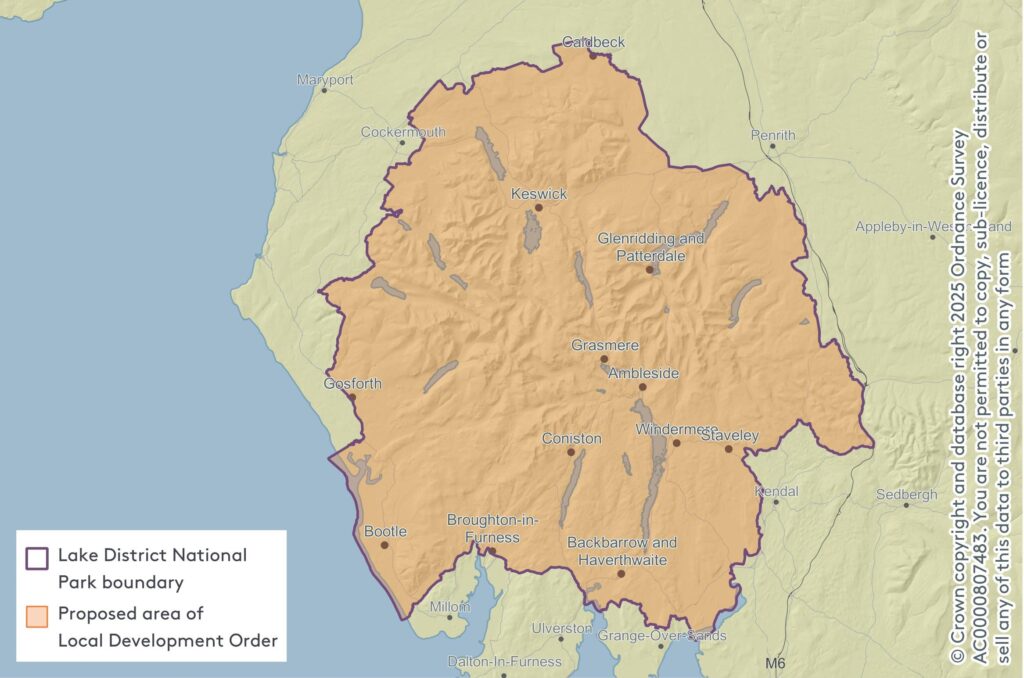
The Lake District National Park Authority adopted a Local Development Order on the 25 November 2025 which permits the replacement of septic tanks with package treatment plants for domestic properties without the need to apply for planning permission.
There are certain limitations which means that you will continue to have to apply for permission in certain locations or if certain criteria are not met. Additionally, the development permitted has to comply with certain conditions. The limitations and conditions are both set out in the Order.
View the Local Development Order PDF.
View the statement of reasons for the Local Development Order PDF.
Frequently asked questions
An increase in nutrients, most commonly nitrogen or phosphorus, can significantly affect water quality and habitats. Natural England has identified areas where nutrification could be particularly harmful because they form the catchment of a protected Habitats Site of international importance, already in an unfavourable condition.
In March 2022, Natural England issued advice that certain new developments, in catchments will need to mitigate against any increase in nutrient pollution that they cause.
Four catchments within Cumbria have been identified, all as a result of excess phosphorus. The affected catchments are listed below:
- River Derwent and Bassenthwaite Lake Special Area of Conservation
- River Eden Special Area of Conservation
- River Kent Special Area of Conservation
- Esthwaite Water RAMSAR
All four fall wholly or partly within the Lake District National Park.
There are various means to achieve reductions in phosphorus – for example through the planting of trees, land use change or creation of wetlands – but one of the most promising is to replace existing, ageing septic tanks with modern package treatment plants which discharge much lower levels of phosphorus.
A potential obstacle to this approach is the need to apply for and receive planning permission for the installation of tanks. Applicants are required to provide plans and other information as part of a planning application and to pay a fee.
We want to make the process of replacing tanks to be as seamless as possible given the benefits of upgrading.
Permitted development rights which allow certain developments to be carried out, for example householders to make alterations to their house, without the need to apply for planning permission.
These rights stem from the Town and Country Planning (General Permitted Development) (England) Order 2015.
Yes. The following conditions apply to all sewage treatment plants permitted under this LDO:
- The sewage treatment plant and drainage field shall be installed, maintained and operated without chemical dosing(d) in accordance with the submitted specification and details hereby approved.
- Any land affected by the works must be reinstated to its previous condition, as far as reasonably possible, unless written confirmation to the contrary is provided by the Local Planning Authority.
- An installation of a sewage treatment plant needs to meet the requirements of the General Binding Rules or, if an environmental permit is required, ensure it is in line with any approved permit.
- Within 42 days of the completion of the development, the developer or landowner shall notify the local planning authority(e) of the installation with the following details:
- A plan to a recognised metric scale showing the location of the sewage treatment plant in relation to the site boundaries. The plan must show the location of the discharge point or drainage field
- The model of the sewage treatment plant installed
- The British Water, or equivalent, accreditation certificate for the system