




New Lake District Local Plan
The Lake District National Park Authority are preparing a new local plan that will guide new development in the Lake District. The new local plan will contain strategic and local planning policies, and site allocations. When adopted, it will replace all previous local plan documents. Click the link below to find out more information.
Explore the different sections of our Local Plan
1. Introduction
[1.1.01] The Local Plan 2020 to 2035 sets out the strategy for all new development in the Lake District. It provides a practical framework within which decisions on planning applications can be made with a high degree of predictability and efficiency. Local Plans are where some of the big decisions on planning for the future of our communities and use of land are made.
[1.1.02] The Local Plan provides planning policies which steer development decisions and guide planning applications. This Plan sets out the strategic policies we consider necessary to address the strategic priorities within the Lake District. These do not extend to detailed matters that are more appropriately dealt with through neighbourhood plans. As well as providing guidance to assess day to day planning applications, it also identifies where and how many new homes should be built, the locations where businesses need more land to expand or to create new jobs and which areas should be protected from development.
[1.1.03] We have produced the Local Plan in cooperation with a variety of stakeholders and in alignment with our Statement of Community Involvement. We have assessed future needs and opportunities within the Lake District, considered a number of options for addressing these needs and opportunities, and identified our suggested approaches. This has involved collecting and analysing evidence, understanding the main issues and discussing these with local communities, businesses and other interested parties.
[1.1.04] We commissioned an independent Sustainability Appraisal (SA) and Habitat Regulations Assessment (HRA) on the Options and Suggested Approach Document, and Published Local Plan. This also includes a Marine Conservation Zone Assessment.
[1.1.05] We have produced Supplementary Planning Documents which provide further guidance on how to implement Policy 04: Biodiversity and geodiversity, Policy 05: Protecting the spectacular landscape, and Policy 15: Housing. These can be accessed on our website www.lakedistrict.gov.uk/localplan.
[1.1.06] Under the Environment Act 1995, the National Park Authority is the sole local planning authority for the Lake District, including the functions for Minerals and Waste. We must use these planning functions to further the National Park purposes and duty.
[1.1.07] Planning law requires that applications for planning permission be determined in accordance with the development plan, which includes local and neighbourhood plans, unless material considerations indicate otherwise. The National Planning Policy Framework is a material consideration in planning decisions. For National Parks the English National Parks and the Broads – UK Government Vision and Circular 2010 is also relevant, providing updated policy guidance on a variety of themes, in particular, the Governments position on the delivery of housing in National Parks.
[1.1.08] On adoption, the Local Plan 2020 to 2035 becomes the Development Plan for the Lake District and replaces (See Appendix 2 for details) the following Local Plan documents:
- Local Plan Part One – Core Strategy (October 2010)
- Local Plan Part Two – Allocations of Land (November 2013)
- Local Plan Part Three – Minerals Safeguarding Areas (November 2013)
- Saved 1998 Local Plan Policies
[1.1.09] Designated in 1951, the Lake District is a mountainous region in North West England of some 2,362 sq. kilometres. As well as being the largest National Park in England, it has a resident population of approximately 40,297 (2017) making it the second most populated National Park in England. Its boundary extends across parts of Eden, Allerdale, Copeland and South Lakeland districts and it encompasses 82 parishes. It is bounded by the M6 and A6 to the east. The A66 and A590 run through the northern and southern areas respectively. It has some of the country’s finest upland scenery which attracts approximately 19 million visitors each year, making tourism a major industry. It was awarded World Heritage Site inscription in 2017.
[1.1.10] The purposes of National Park designation were first established in the 1949 National Parks and Access to the Countryside Act. The Environment Act 1995 revised the original legislation and set out two statutory purposes:
- Conserve and enhance the natural beauty, wildlife and cultural heritage
- Promote opportunities for the understanding and enjoyment of the special qualities of national parks by the public
In pursuing the statutory purposes, National Park Authorities also have a duty to:
- Seek to foster the economic and social well-being of local communities within the national park
[1.1.11] Within the Lake District there are many different interests to manage. Protection of the spectacular landscape, delivering economic prosperity, enhancing vibrant and resilient communities and enabling world class tourism – the challenges and opportunities are endless. And it is widely acknowledged that the Lake District is a living, man-made cultural landscape that has evolved over time and needs to continue evolving to sustain its future.
[1.1.12 ] Section 11A of the National Parks and Access to the Countryside Act 1949 (amended by Section 62 of the Environment Act 1995) makes clear that if National Park purposes are in conflict then conserving and enhancing the natural beauty, wildlife and cultural heritage of the area must have priority. This Section of the Act enshrines in law the Sandford Committee’s recommendations, commonly known as the ‘Sandford Principle’. It is also made clear in the Act that this applies to all relevant authorities such as statutory undertakers and local authorities:
“In exercising or performing any functions in relation to, or so as to affect, land in a National Park, any relevant authority shall have regard to the purposes… and, if it appears that there is a conflict between those purposes, shall attach greater weight to the purpose of conserving and enhancing the natural beauty, wildlife and cultural heritage of the area comprised in the National Park.”
[1.1.13] We will encourage and support development that is sustainable in the context of the Lake District and national planning policy on the presumption in favour of sustainable development. We have prepared this Plan to enable this to take place. Taken as a whole the Plan’s policies and principles of development outline what we consider to be sustainable development in the Lake District context but we recognise that this may change over time and therefore commit to a regular review of the Plan in line with the National Planning Policy Framework.
2. Our Vision and Strategic Objectives
[2.1.01] We believe that fundamental to our ability to manage the Lake District is that we have a clear Vision for how we ultimately want the place to be. The Vision and Vision Outcomes were agreed by the Lake District National Park Partnership in 2006, and were reviewed as part of the preparation of the Lake District National Park Partnership’s Plan 2015–2020. In order to deliver our collective vision our strategic objectives all relate to delivery of this Vision. The Strategic Objectives for the Local Plan are presented as “specifically this means” and the “cross cutting objectives”.
The 2030 Vision for the English Lake District is that it will be:
An inspirational example of sustainable development in action.
- A place where its prosperous economy, world class visitor experiences and vibrant communities come together to sustain the spectacular landscape, its wildlife and cultural heritage.
- Local people, visitors, and the many organisations working in the Lake District or have a contribution to make to it, must be united in achieving this.
The 2030 Vision for the English Lake District is that it will be an inspirational example of sustainable development in action – see our four headings below and how they link to our Strategic Objectives:
We will see the following Vision outcome:
Businesses will locate in the National Park because they value the quality of opportunity, environment and lifestyle it offers – many will draw on a strong connection to the landscape. Entrepreneurial spirit will be nurtured across all sectors and traditional industries maintained to ensure a diverse economy.
Specifically this means:
- A diverse and growing economy, supporting higher paid jobs, utilising a range of employment spaces that provide a choice of employment opportunities for everyone.
- Profitable and sustainable land management, farming, and forestry industries.
- The Lake District is a year round destination with more longer staying visitors supporting the economy.
We will see the following Vision outcome:
People successfully living, working and relaxing within upland, valley and lakeside places where distinctive local character is maintained and celebrated.
Specifically this means:
- A balanced and resilient housing market with a high proportion of properties in permanent occupation, and a supply of new homes that meet local people’s needs and maximises the delivery of affordable housing.
- Community and cultural facilities and local services are sustained, and communities have improved availability and access to well paid jobs, high quality greenspaces, recreation facilities and the countryside.
We will see the following Vision outcome:
High quality and unique experiences for visitors within a stunning and globally significant landscape. Experiences that compete with the best in the international market.
Specifically this means:
- Changing visitor expectations are met by a diverse range of quality accommodation.
- Every visitor has the best experience that the Lake District offers through improved attractions, high quality public realm and amenities, and accessible visitor information; in turn appreciation and understanding of the Lake District is enhanced.
We will see the following Vision outcome:
A landscape which provides an irreplaceable source of inspiration, whose benefits to people and wildlife are valued and improved. A landscape whose natural and cultural resources are assets to be managed and used wisely for future generations.
Specifically this means:
- The extraordinary beauty and harmony of the Lake District landscape and its Special Qualities and attributes of Outstanding Universal value are conserved and enhanced.
- Design is inspired by and contributes to local distinctiveness, and natural resources and cultural heritage assets are conserved, enhanced, utilised, and managed.
- Bigger, better and more joined up resilient habitats support wildlife and species, and the function of ecosystems are improved whilst the evolution of the cultural landscape is respected.
[2.1.02] Special Qualities distinguish National Parks from each other and other areas of the country. All of the Special Qualities of the Lake District contribute in different ways to the Outstanding Universal Value of the area recognised by World Heritage Site Status. As this is the case all of the attributes of Outstanding Universal Value are specific aspects of each of the Special Qualities. This is demonstrated in Table 1. Full descriptions of the Special Qualities are found in the Partnership’s Plan 2015-2020, as are the attributes of Outstanding Universal Value for each valley.
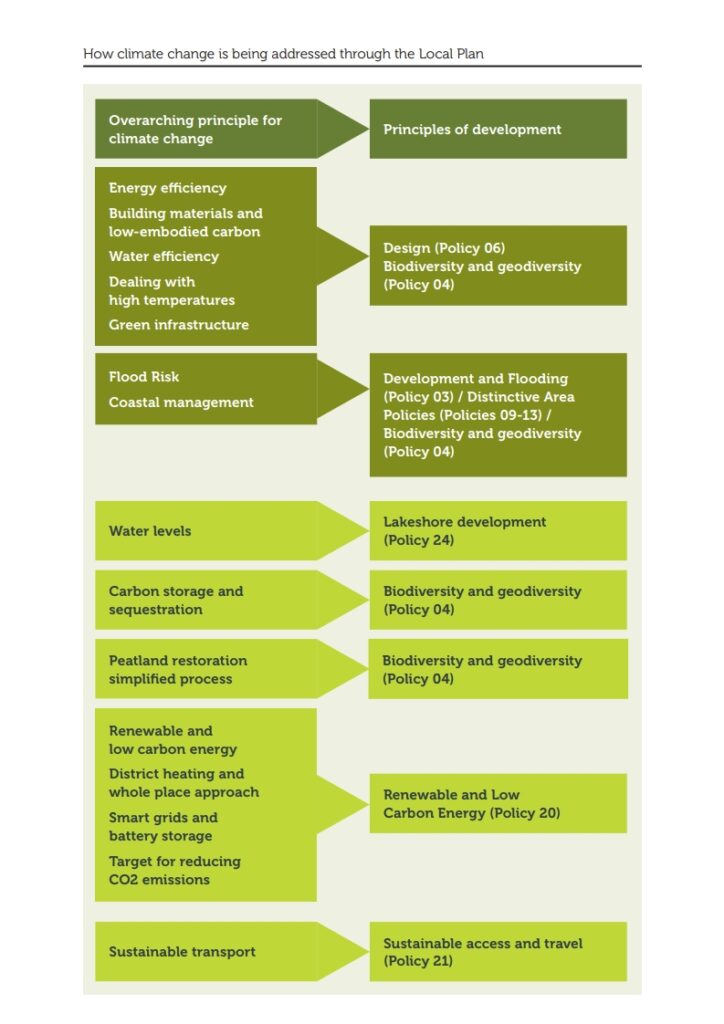
[2.1.03] Climate change is already having a direct impact upon what the Lake District looks like and how its environment, society, and economy will function in the future. Our strategic response to the risks that climate change presents to the Vision, Special Qualities and attributes of Outstanding Universal Value must be holistic, rather than limited to a single strategy. Therefore we have addressed climate change through a number of our policies in this document including ‘Principles of development’, ‘Development and flooding’, ‘Biodiversity and geodiversity ’, ‘Design and development’, ‘Lakeshore development’, ‘West Distinctive Area’ (in relation to Coast) and ‘Renewable and low carbon energy’.
Health and Wellbeing
An important contribution to the nation’s wellbeing is made by opportunities in the Lake District as people benefit physically and mentally.
Connectivity and Infrastructure
People and businesses have complete coverage of digital infrastructure in every valley.
People move easily between destinations utilising enhanced, integrated, and sustainable transport services and infrastructure, travel and orientation information, delivering a better choice of attractive travel options.
World Heritage and Local Character
Distinctiveness of place and individual character of valleys is recognised, and reflected by the character and form of new development, enabling the appropriate evolution and benefits befitting a National Park and World Heritage Site.
Climate Change and Resilience
Resilience to climate change and extreme weather events is improved by greater adaptation and mitigation. Improved energy efficiency, local scale energy generation, improved sustainable travel options, and reducing the need to travel reduce the Lake District’s Carbon Budget and mitigate predicted effects of climate change.
3. Strategic policies
4. Land allocations
Our allocations of land pages shows all the sites allocated for different development needs under Policy 14, in each of the five distinctive areas.
View our interactive policies map to view the policies and site allocations of the Local Plan 2020-2035.
5. Monitoring, implementation and review
[5.1.01] Monitoring is essential to establish what is happening and what may happen in the future and it means we can compare trends against existing policies to assess performance and whether we need to make changes. We assess the progress and effectiveness of planning policies set out in the Local Plan by asking:
- are policies achieving their intention, and is sustainable development being delivered?
- have policies had or are they having the intended consequences?
- are the strategic objectives behind the policies still relevant?
- are the targets set out in the Local Plan being achieved?
[5.1.02] The Local Plan will be monitored regularly over the plan period via the Annual Monitoring Report. We will monitor the Plan as a whole, and use the list of indicators in Table 2 to inform the Annual Monitoring Report. It provides us with the opportunity to critically evaluate the effectiveness of our planning policies and monitor if a policy is working. We can also use it to identify and consider any changes in local circumstances which may influence the effectiveness of our policies.
[5.1.03] The Annual Monitoring Report is used to monitoring trend data over time and can be used as a trigger to either initiate a review of the Local Plan or introduce additional guidance on how to implement a policy, if required.
[5.1.04] We have established two types of indicator which are either ‘core’ or ‘contextual ’. Core indicators monitor the effectiveness of the policies within the Local Plan whereas the contextual indicators provide additional information that has a wider contextual benefit such as linking to the State of the Park Report. Where we identify ‘bigger better’ or ‘smaller better’ as a target these reflect circumstances where the intention of the policy is to effect a specific change or outcome. Where ‘no target’ has been specified this reflects the indicators are largely contextual or respond to individual circumstance.
[5.1.05] The aspirations of Local Plan, determined by the Vision and Strategic Objectives, will be delivered with the support of landowners, members of the community and the Lake District National Partnership.
Economy and employment
| Objective | Indicator | Target | Source of data | Relevant policy | Indicator type |
|---|---|---|---|---|---|
|
Objective
Support the development of new employment sites and buildings (including retail and tourism) |
Indicator
Amount and net change of floor space granted planning permission for employment by type, by location and by Distinctive Area |
Target
A net increase |
Source of data
Planning Applications |
Relevant policy
Policy 16 |
Indicator type
Contextual |
|
Objective
” “ |
Indicator
Amount of employment floorspace lost to residential use |
Target
Smaller better |
Source of data
Planning Applications |
Relevant policy
Policy 16 |
Indicator type
Core |
|
Objective
” “ |
Indicator
Amount and net change of floor space completed for employment by type, by location and by Distinctive Area |
Target
A net increase |
Source of data
Planning Applications |
Relevant policy
Policy 16 |
Indicator type
Contextual |
|
Objective
” “ |
Indicator
Number of jobs (full-time equivalent) created by type and location Trigger – Not achieving target for three consecutive years |
Target
190 FTE per annum |
Source of data
Planning Applications |
Relevant policy
Policy 16 |
Indicator type
Core |
|
Objective
” “ |
Indicator
Amount and net change of commercial, business and service floorspace created in Primary Shopping Area |
Target
A net increase |
Source of data
Planning Applications |
Relevant policy
Policy 17 |
Indicator type
Contextual |
|
Objective
” “ |
Indicator
Amount and net change of commercial, business and service floorspace created in Rural Service Centres |
Target
A net increase |
Source of data
Planning Applications |
Relevant policy
Policy 17 |
Indicator type
Contextual |
|
Objective
” “ |
Indicator
Amount and net change of commercial, business and service floors pace created in Villages, Clusters and Open Countryside |
Target
No target |
Source of data
Planning Applications |
Relevant policy
Policy 17 |
Indicator type
Contextual |
|
Objective
Support development for local / traditional businesses and activities |
Indicator
Number of applications received and percentage approved for agricultural diversification |
Target
Bigger better |
Source of data
Planning Applications |
Relevant policy
Policy 19 |
Indicator type
Core |
|
Objective
” “ |
Indicator
Number of applications received and percentage approved for mineral extraction |
Target
No target |
Source of data
Planning Applications |
Relevant policy
Policy 27 |
Indicator type
Core |
|
Objective
” “ |
Indicator
Increase in physical extension to the area of mineral extraction |
Target
No target |
Source of data
Planning Applications |
Relevant policy
Policy 27 |
Indicator type
Contextual |
|
Objective
” “ |
Indicator
Number of Whole Estate Plans endorsed by the LDNPA |
Target
No target |
Source of data
PSV Committee |
Relevant policy
Policy 19 |
Indicator type
Contextual |
|
Objective
Diversity of the economic base |
Indicator
Percentage of population that is of working age |
Target
No target |
Source of data
Annual employment survey |
Relevant policy
Policy 16 |
Indicator type
Contextual |
|
Objective
” “ |
Indicator
Percentage of working age population employed by non-visitor economy sectors |
Target
No target |
Source of data
Annual employment survey |
Relevant policy
Policy 16 |
Indicator type
Contextual |
Vibrant communities
| Objective | Indicator | Target | Source of data | Relevant policy | Indicator type |
|---|---|---|---|---|---|
|
Objective
To improve the health and wellbeing of people |
Indicator
Amount of new development creating community facilities |
Target
A net increase |
Source of data
Planning Applications |
Relevant policy
Policy 23 |
Indicator type
Contextual |
|
Objective
” “ |
Indicator
Amount of Local Green Space lost through alternative uses |
Target
Smaller better |
Source of data
Planning Applications |
Relevant policy
Policy 23 |
Indicator type
Contextual |
|
Objective
” “ |
Indicator
Number of community facilities lost to alternative uses |
Target
Smaller better |
Source of data
Planning Applications |
Relevant policy
Policy 23 |
Indicator type
Contextual |
|
Objective
Making Communities more resilient |
Indicator
Number of houses granted planning permission by type, by location and by Distinctive Area Trigger – Not achieving target for three consecutive years |
Target
80 per annum |
Source of data
Planning Applications |
Relevant policy
Policy 15 |
Indicator type
Core |
|
Objective
” “ |
Indicator
Percentage of new dwellings approved with a permanent occupancy restriction |
Target
Bigger better |
Source of data
Planning Applications |
Relevant policy
Policy 15 |
Indicator type
Core |
|
Objective
” “ |
Indicator
Number of houses completed on allocated sites and windfall sites |
Target
80 per annum |
Source of data
Planning Applications |
Relevant policy
Policy 15 |
Indicator type
Core |
|
Objective
” “ |
Indicator
Number of houses completed on previously developed land |
Target
Bigger better |
Source of data
Planning Applications |
Relevant policy
Policy 15 |
Indicator type
Contextual |
|
Objective
” “ |
Indicator
Density of approved housing on allocated sites |
Target
No target |
Source of data
Planning Applications |
Relevant policy
Policy 14 and Policy 15 |
Indicator type
Contextual |
|
Objective
” “ |
Indicator
Density of approved housing for more than five units in Rural Service Centres |
Target
No target |
Source of data
Planning Applications |
Relevant policy
Policy 15 |
Indicator type
Contextual |
|
Objective
” “ |
Indicator
Number of homes built on Operational farms |
Target
A net increase |
Source of data
Planning Applications |
Relevant policy
Policy 15 |
Indicator type
Core |
|
Objective
” “ |
Indicator
Number of applications received and percentage approved by community led housing groups |
Target
Bigger better |
Source of data
Planning Applications |
Relevant policy
Policy 15 |
Indicator type
Contextual |
|
Objective
” “ |
Indicator
Number of applications received and percentage approved for change of use of guest houses to residential including number of additional houses completed |
Target
No target |
Source of data
Planning Applications |
Relevant policy
Policy 15 |
Indicator type
Core |
|
Objective
” “ |
Indicator
Number of settlements in the Lake District with four, five or six services from: convenience store, meeting place, primary school, public house, post office, doctors surgery |
Target
Bigger better |
Source of data
In house survey |
Relevant policy
Policy 02 and Policy 23 |
Indicator type
Core |
|
Objective
” “ |
Indicator
Number of applications received and percentage approved for multi-uses of community facilities |
Target
No target |
Source of data
Planning Applications |
Relevant policy
Policy 23 |
Indicator type
Core |
|
Objective
” “ |
Indicator
Number of units granted planning permission for holiday letting which are new build |
Target
0 per annum |
Source of data
Planning Applications |
Relevant policy
Policy 18 |
Indicator type
Core |
|
Objective
” “ |
Indicator
Number of planning permissions granted contrary to Environment Agency advice on flooding and water quality grounds |
Target
Smaller better |
Source of data
Planning Applications |
Relevant policy
Policy 03 |
Indicator type
Core |
|
Objective
” “ |
Indicator
Percentage of housing applications approved which meet the 30 per cent renewable energy target |
Target
Bigger better |
Source of data
Planning Applications |
Relevant policy
Policy 20 |
Indicator type
Core |
|
Objective
” “ |
Indicator
Percentage of other developments of greater than 100 square metres floorspace approved which meet the 30 per cent renewable energy target |
Target
Bigger better |
Source of data
Planning Applications |
Relevant policy
Policy 20 |
Indicator type
Core |
Visitor experience
| Objective | Indicator | Target | Source of data | Relevant policy | Indicator type |
|---|---|---|---|---|---|
|
Objective
Every visitor has the best experience through improved attractions, access and transport |
Indicator
Amount and net change of floor space granted planning permission for tourism by type, by location and by Distinctive Area |
Target
A net increase |
Source of data
Planning Applications |
Relevant policy
Policy 18 |
Indicator type
Contextual |
|
Objective
” “ |
Indicator
Number of applications received and percentage approved for change of use from guesthouses to different forms of holiday accommodation |
Target
No target |
Source of data
Planning Applications |
Relevant policy
Policy 18 |
Indicator type
Contextual |
|
Objective
Promote development that provides and or improves sustainable and integrated transport within the Lake District |
Indicator
Number of applications received and percentage approved for sustainable access and travel proposals |
Target
Bigger better |
Source of data
Planning Applications |
Relevant policy
Policy 21 |
Indicator type
Core |
|
Objective
” “ |
Indicator
Number of applications received and percentage approved for vehicle parking proposals as part of sustainable transport improvements |
Target
No target |
Source of data
Planning Applications |
Relevant policy
Policy 22 |
Indicator type
Core |
|
Objective
” “ |
Indicator
Number of additional parking spaces granted through planning permission by location |
Target
No target |
Source of data
Planning Applications |
Relevant policy
Policy 22 |
Indicator type
Contextual |
|
Objective
Increase length of stay of overnight visitors |
Indicator
Number of bed spaces created by type, by location and by Distinctive Area |
Target
A net increase |
Source of data
Planning Applications |
Relevant policy
Policy 18 |
Indicator type
Contextual |
|
Objective
” “ |
Indicator
Number of applications received and percentage approved for the reuse of existing buildings for holiday letting |
Target
A net increase |
Source of data
Planning Applications |
Relevant policy
Policy 18 |
Indicator type
Contextual |
|
Objective
Encourage year round sustainable tourism |
Indicator
Number of applications received and percentage approved for year round use of camping and caravanning sites |
Target
A net increase |
Source of data
Planning Applications |
Relevant policy
Policy 18 |
Indicator type
Core |
Landscape and cultural heritage
| Objective | Indicator | Target | Source of data | Relevant policy | Indicator type |
|---|---|---|---|---|---|
|
Objective
To preserve, enhance and manage landscape quality and character for future generations |
Indicator
Number of applications received and percentage approved contrary to Policy 05: Protecting the Spectacular Landscape |
Target
Smaller better |
Source of data
Planning Applications |
Relevant policy
Policy 05 |
Indicator type
Core |
|
Objective
” “ |
Indicator
Number of applications received and percentage approved contrary to Policy 06: design and development |
Target
Smaller better |
Source of data
Planning Applications |
Relevant policy
Policy 06 |
Indicator type
Core |
|
Objective
” “ |
Indicator
Number of applications received and percentage approved contrary to Policy 24: Lakeshore development |
Target
Smaller better |
Source of data
Planning Applications |
Relevant policy
Policy 24 |
Indicator type
Core |
|
Objective
” “ |
Indicator
Number of applications received and percentage approved contrary to Policy 25: Development for the keeping of animals on a non-commercial basis |
Target
Smaller better |
Source of data
Planning Applications |
Relevant policy
Policy 25 |
Indicator type
Core |
|
Objective
” “ |
Indicator
Number of major development applications approved against Policy 26: Major Development |
Target
Smaller better |
Source of data
Planning Applications |
Relevant policy
Policy 26 |
Indicator type
Core |
|
Objective
To improve the quality of the built and natural environment, including the historic environment, heritage assets and their setting. |
Indicator
Number of applications received and percentage approved contrary to Policy 04: Biodiversity and geodiversity |
Target
Smaller better |
Source of data
Planning Applications |
Relevant policy
Policy 04 |
Indicator type
Core |
|
Objective
” “ |
Indicator
Number of applications where there is a 10% or more increase in biodiversity units as measured by the biodiversity metric |
Target
Bigger better |
Source of data
Planning Applications |
Relevant policy
Policy 04 |
Indicator type
Core |
|
Objective
” “ |
Indicator
Number of applications received and percentage approved contrary to Policy 07: Historic environment |
Target
Smaller better |
Source of data
Planning Applications |
Relevant policy
Policy 07 |
Indicator type
Core |
|
Objective
” “ |
Indicator
Number of listed buildings removed from Heritage at Risk register through works completed |
Target
Bigger better |
Source of data
Heritage at Risk Register |
Relevant policy
Policy 07 |
Indicator type
Contextual |
|
Objective
” “ |
Indicator
Number of Scheduled Ancient Monuments removed from Heritage at Risk register through works completed |
Target
Bigger better |
Source of data
Heritage At Risk Register |
Relevant policy
Policy 07 |
Indicator type
Contextual |
|
Objective
” “ |
Indicator
Number of applications received and percentage approved for change of use of a building of archaeological or historic importance to economic or residential uses |
Target
A net increase |
Source of data
Planning Applications |
Relevant policy
Policy 07 and Policy 02 |
Indicator type
Contextual |
6. Glossary
View our Local Plan glossary page.
7. Superseded Policies
Visit our superseded policies page for the current development plan policy that will cease to have effect.