
Infographic
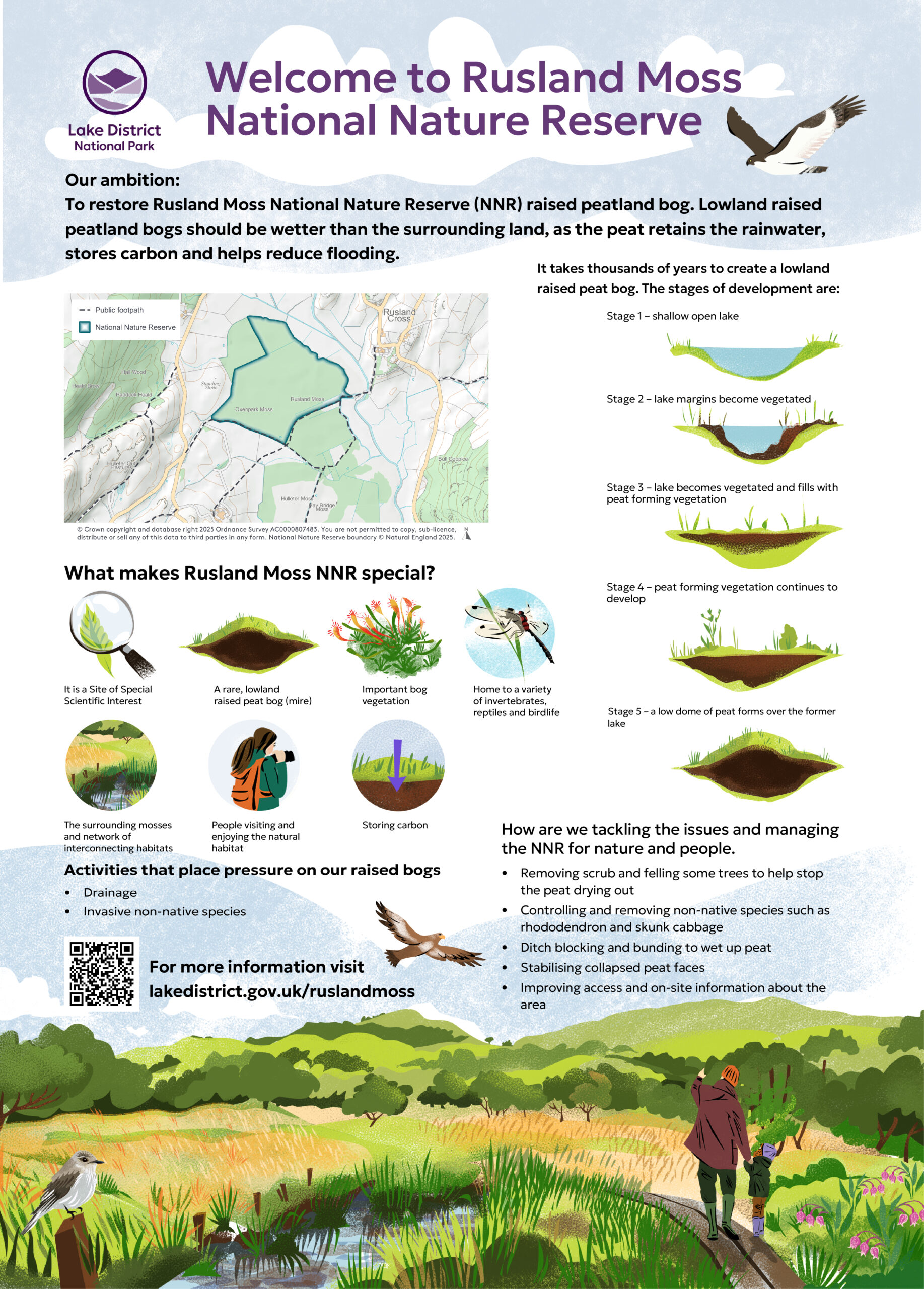
Below is an infographic showing the stages of a lowland raised peat bog, what makes Rusland Moss National Nature Reserve special and how we’re managing the issues it currently faces.
Lowland peat restoration
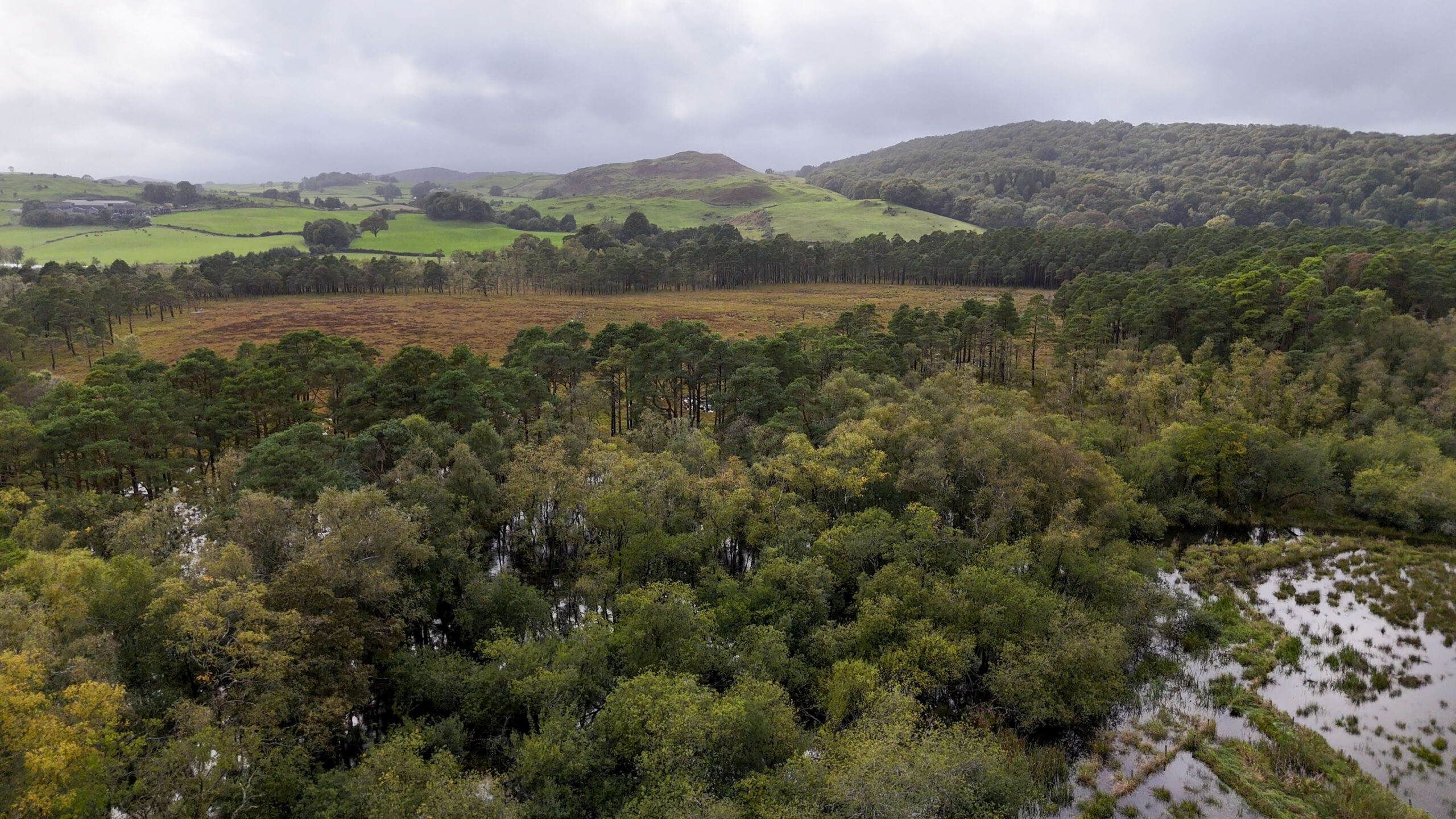
Rusland Moss is a raised bog situated near the head of the Rusland Valley, 4 km north-west of Newby Bridge. Rusland Moss together with the adjoining Hulleter and Hay Bridge mosses to the south form the Rusland Valley Mosses Site of Special Scientific Interest. The site was notified in recognition of the national and international importance of the lowland raised bogs.
Peat began to form on the land at Rusland around 3,000 to 4,000 years ago. Peat is formed from the accumulation over time of dead bog plants due to the lack of oxygen underwater and an acidic pH. Peat consists of partially decomposed and preserved plant remains, primarily peat mosses (Sphagnum). Sphagnum moss is known as the ‘bog builder’ because it holds water (lowering oxygen levels) and secretes acid, keeping conditions suitable for peat formation and specialist plants. Raised bogs are exclusively fed by rainfall. Also, bogs are important to people who visit to relax, explore and unwind, enjoying the tranquillity of the vast open expanses’ that bogs offer
Peat cuttings drainage and scrub and woodland encroachment have all contributed to the drying out of the site. Left alone, the peat would continue to decay and the bog would become covered in birch, pine and rhododendron with purple moor-grass beneath.
As part of the management of the site we want to restore the bog to a near-natural state so we can preserve the existing peat. Peatlands cover less than 3 per cent of the land surface of Earth but are thought to contain twice as much carbon as the world’s forests. We recognise the importance of peatlands and the remarkable services they provide to society, which includes wildlife habitat, global carbon store, drinking water filtration, flood prevention, historical archive, grazing land and recreational areas. The raised bog at Rusland Moss has been damaged by drainage and peat cutting. Left alone, the peat would continue to decay and the bog would become covered in birch, pine and rhododendron with purple moor-grass beneath. Our intention is to restore the bog back to favourable condition by:
- Removing scrub and felling trees where they are drying out the peat.
- Removing rhododendron.
- Keeping rainwater on the bog by blocking old ditches across the bog and with peat dams or ‘bunds’.
- Stabilising collapsing peat faces.
Frequently asked questions
National Nature Reserves (NNRs) were established to protect some of our most important habitats, species and geology, and to provide ‘outdoor laboratories’ for research. Most NNRs offer great opportunities to schools, specialist interest groups and the public to experience wildlife at first hand and to learn more about nature conservation.
NNRs owned and managed by the LDNPA are open to the public, and we welcome all our visitors to connect with nature and be inspired by our fantastic wildlife, habitats, geology and landscapes. Natural England manages about two thirds of England’s NNRs. The remaining reserves are managed by organisations approved by Natural England, such as LDNPA.
LDNPA has owned and leased areas of Rusland Moss NNR since 1981 and over that time has been working to restore more natural conditions at Rusland Moss NNR in order to protect the rare habitat and species, conserve the carbon and historical record in the peat and to re-establish the bog’s ability to lay down more peat.
Bogs are a type of peatland. Peatlands have many names for the different types – bogs, mosses, mires, fens. Rusland Moss is a lowland raised bog. In the UK we have lost almost all of our lowland raised bog and there are no undamaged sites left.
A video of the key aspects of the development of a raised bog can be viewed below the FAQs.
Peat is a type of soil that is created when plants die in waterlogged conditions and so don’t rot down. It has no or only low amounts of minerals. Because of the lack of oxygen, the vegetation doesn’t fully rot down (or does so very slowly), so the layers of peat build up and can become very deep. Peat can be made from any plant remains but the main peat-formers are bog-mosses, (sphagnum) and cotton-grasses. Bog-mosses are key peat-formers because they store large amounts of water in their cells and they also make the water more acidic.
Bogs are beautiful, dramatic landscapes, full of inspiring wildlife and bogs also provide us with some services vital to our own survival. Some key services that we get free from bogs:
- a significant percentage of our good quality drinking water comes from upland bogs.
- the bog vegetation ‘drinks up’ the rainfall and stores it in the bog thus helping to reduce flooding.
- bogs can lock up carbon for thousands of years in the plant remains that form peat. Damaged peat bogs are net carbon emitters but active bogs are able to store significantly more carbon than other habitats such as woodland.
The ability of bogs to carry out these functions has been severely disrupted by human activity such as peat extraction, bog drainage and agriculture. Their protection is necessary to avoid adverse economic and environmental impacts. Restoring damaged bogs has a recognised role in managing climate change.
Bog habitats support many specialist plants (sundews, cotton-grass and bog-moss (sphagnum) species). Did you know that a sundew is carnivorous? They are ‘fly paper’ plants, capturing insects on stalked, sticky glands on their leaves to get extra nutrients.
Lowland raised bogs are home for rare animals including birds that like wet or open places, invertebrates (like large heath butterfly and bog bush cricket) and reptiles (adders).
Bogs are living history books. The semi-decayed plant, animal (and sometimes human) remains in the peat provide a record of cultural, climatic and vegetation changes dating back thousands of years.
Bogs have a cultural history, for example in the peat-cutting practices (household and commercial) and in uses such as in World War I. When sterile dressings became scarce, Sphagnum mosses were used to dress patients’ wounds. Sphagnum is adapted to storing large amounts of water and it was capable of absorbing more than twice as much blood and fluids as cotton wool, thus initially helping to dry out the wound. Sphagnum also releases a chemical called “sphagnum”, which prevents infection of the wound.
Peatlands are in trouble. Globally, 25% of peatlands have been destroyed, whilst here in the UK at least 80% are believed to be damaged. The damage comes from a range of pressures, some of which are historic issues which continue to damage our peatlands.
Damage to bogs has been/is caused by:
- Burning and overgrazing that intensifies erosion in some areas
- Peat extraction for horticulture and development
- Atmospheric pollution including historic sulphur deposits and ongoing nitrogen deposition
- Drainage for agriculture and forestry planting for timber
Damaged peat results in:
- Millions of tons of carbon being released into the atmosphere every year
- Brown-coloured water which is expensive for water companies to treat before we can drink it
- Wildlife declining due to significantly reducing habitat
- Ongoing worsening climate change
Rusland Moss together with Hulleter and Hay Bridge mosses to the south form the Rusland Valley Mosses Site of Special Scientific Interest. The site was notified in recognition of the national and international importance of the lowland raised bogs, important and relatively intact lowland raised mire plant communities at Rusland, and its diverse invertebrate assemblage. Rusland Moss National Nature Reserve (NNR) is on land owned and managed by LDNPA. The rest of the land within the SSSI is mainly in private ownership.
Rusland Mosses SSSI comprises of three separate domes, Hulleter Moss, Hay Bridge Moss and the highest, Rusland Moss which rises to 8 m above sea level. They form one of the few remaining examples of the formerly extensive system of estuarine raised mires around Morecambe Bay.
Peat began to form on the land at Rusland around 3,000 to 4,000 years BP. As the peat gradually rose above the surrounding catchment over time it became perched and isolated. The physical properties of the peat and the Sphagnum moss that it is developed from, allowed a high and stable water table to form which created wet conditions that were maintained solely through water supplied by the incident precipitation.
The Rusland Valley Mosses are no longer intact. Peat cuttings, drainage (on site and in the surrounding area), and scrub and woodland encroachment have all contributed to a general fall in the height of the water table across the site. With this lowering, the majority of the raised bog habitats have been replaced with drier ones.
There are two deep depressions, on the western side of the site, where the deepest peat now lies and is up to 8 m thick. The peat thins out towards the edges. In these areas, the peat moves towards becoming peaty soil rather than true peat <0m.
Current extent of deep peat is > 30cm.
There is no accurate measurement on the amount of carbon being stored or lost from the Moss.
Although the site has suffered damage in the past from drainage and peat-cutting, the reserve retains peat forming vegetation and has some surrounding fen.
A carpet of sphagnum moss, interspersed with reindeer lichen and overlain, in the summer, by cotton-grasses, bog rosemary, cranberry, heathers, sundew and bog asphodel are prominent in the uncut areas of the Moss, with purple moor-grass and bog myrtle in the cut areas and fen and carr woodland at the edges.
There are many different insects on the moss, including the raft spider which was first recorded in Britain on Rusland Moss and the nationally rare money spider. Large heath and green hairstreak butterflies can often be seen from the boardwalk. This is a great place for birds such as buzzard, spotted flycatcher and wood warbler. Red and roe deer are also present on the site.
We recognise the importance of peatlands and the remarkable services they provide to society, which includes wildlife habitat, global carbon store, drinking water filtration, flood prevention, historical archive, grazing land and recreational areas. The raised bogs have been damaged by past drainage and peat cutting. Left alone, the peat would continue to decay and the bog would become covered in birch, pine and rhododendron with purple moor-grass beneath. By restoring the water regime in the peat to a near-natural state we can preserve the existing peat along with its carbon and historic record, and allow the peat-forming vegetation, dominated by bog-mosses, to become active again. The active bog is a rare historic landscape and home not only to the specialist bog plants and animals but also a refuge for species that have declined in the wider countryside through reduction of their own habitats.
In the past we have had a management plan that is reviewed every five years. Our intention is to produce a new management plan for the site in parallel to finalising a peatland restoration plan. To inform the plan, we consult our neighbours, interested individuals, organisations involved in nature conservation and access and statutory bodies that need to know what we are proposing at an early stage. We consult the Parish Council as representatives of the local community. Some of the works we want to carry out require permissions from statutory bodies. Felling licences and planning permissions are granted after public consultation and the Parish Council is one of the statutory consultees.
Feasibility work
Although many surveys have been undertaken in the past looking at peat depths, species and habitats and flood risk to help inform future restoration work Cumbria Wildlife Trust will be carrying out a feasibility study to review all the existing information, taking into consideration which animals and plants might be affected by bog restoration and how we can avoid or mitigate the effects, detailed surveys of certain species (otters / deer), vegetation types will be undertaken. This will help to produce a final draft of a restoration plan.
Post restoration works we intend to periodically carry out monitoring though vegetation survey and fixed point photographs to see how the bog vegetation is responding to management and whether unmanaged areas are declining.
The restoration work will involve:
Removing scrub and felling trees where they are drying out the peat.
Dense trees, mainly young birch and Scots pine?) have a detrimental effect on the bog as they dry out the peat and shade the bog vegetation. They may also restrict access for repairs to ditches and collapsing peat faces. We leave as many trees as possible and aim to keep scattered trees, the oldest trees and species like oak and rowan that do not harm the bog. It is unlikely that any trees are suitable for bat roosts but we will be looking for them and we will also try and maintain flight lines.
Once the work is finished, we will let the trees grow back. We are not aiming for a tree-free bog, we want to see a scatter of stunted trees across the bog to provide structural variety for animals without affecting the bog vegetation.
Where possible we will remove felled timber for use as firewood. Often this is impractical and then we leave logs stacked ‘wildlife piles’. Large amounts of branches are usually chipped and the chips left in piles if they cannot be removed. Wood left on the bog will either rot down or be incorporated in the peat.
Removing rhododendron. This non-native plant grows well from seed, even in wet conditions and spreads quickly. It can get to 7 metres or so in height and spreads out indefinitely, forming an impenetrable mass of branches that root into the ground where they touch. Rhododendron can shade out all other plants except the tallest trees and the dense canopy means that little rainwater can reach the bog surface. Rhododendron efficiently dries out the peat and the subsidence beneath bushes is obvious when they are cut back. Control of this plant will need to be ongoing as bushes need to be repeatedly cut before they die and new plants seed in continually from adjacent land.
Keeping rainwater on the bog by blocking old ditches across the bog and peat cracks with peat dams or ‘bunds’. Bunds are underground dams made of peat obtained from the area next to the bund. They protrude about 15 cm above the surface, plus the vegetation replaced on top, and this slows surface flows whilst the ‘cells’ between the bunds infill with vegetation over the next 10-15 years. The many cells mean that each only holds a small amount of water and most open water has gone within a year. Bunding is also used to slow surface flows and repair cracks where the surface of the bog is sloping. Occasionally, plastic piling is used where ditches are very wide or the peat is very degraded, but we avoid this as far as possible.
Stabilising collapsing peat faces by regrading them to an angle of no greater than 30 degrees. This will help to stop the bog behind from collapsing further and will slow the loss of rainwater over the surface and directly through the cut face.
Bog restoration work takes place in the autumn or winter months and during daylight hours. Neighbours will see and hear the vehicles while in operation, but the work will be done as effectively and efficiently as safety allows. Contractors can normally leave machinery on the bog during the works. Any damage to access tracks will be repaired as part of the contract. It may be necessary to shut paths and boardwalks for safety reasons where contractors are using machinery or chainsaws in the vicinity but we will do so for the minimum time.
We have identified areas where work needs to take place to mend the bog though our timetable will depend on resources such as obtaining necessary permissions, funding, staff time and availability of specialist contractors.
We will give notice by putting up temporary signs that describe the work and the timing and provide a contact for queries. These temporary signs are laminated and displayed close to entry / access points. This is a method of notifying the general public that other organisations also use. When our contractors are working on any of our sites, we also require them to ensure notices are displayed at appropriate access points, particularly where machinery is used.
Research and modelling work to date indicates that changes in floodplain water storage as a result of the work will not increase flood risk elsewhere in the catchment. Raised bogs are basically a mound of peat that is higher than the surrounding land. The peat has its own water table that is fed entirely by rainfall, snow and fog. Water in undrained peat moves extremely slowly; most water leaving the bog does so via the historic drainage ditches and surface flows. Our objective to ‘raise the water table’ relates only to the water table in the peat of the raised bog. Blocking the ditches and enabling the highly water-absorbent bog vegetation to recover will keep rainwater on the bog for longer and reduce and delay the amount that leaves. After restoration, excess rainwater leaving the bog will continue to go into the existing agricultural drainage network.
Reducing the amount and rate of loss of rainwater from the bog and delaying runoff following intense rainfall is a positive contribution to increasing capacity and reducing peak levels in the surrounding agricultural ditch network and drainage system.
As part of the feasibility work we will review the flood assessment carried out in 2014. This will be an integral part of obtaining planning permission. The flood assessment looks at:
- Changes in peak run-off during storm events,
- Impacts of raised groundwater levels on sensitive receptors,
- Impacts on fluvial flood risk – this is the potential overflow onto the neighbouring land.
A public footpath runs along the southwestern and south eastern boundary of the NNR. We want to maintain the paths to keep them accessible and reduce erosion of the surface in wet places. We also intend to improve to access and the site information during the bog restoration works.
The trees that we want to remove are mainly birch up to 30 years old. These trees are thin and tall as they have grown in crowded conditions. Birch normally live for about 50 years in woodland and it is likely to be less on a bog. In contrast, peat can store carbon for thousands of years and continues to accumulate as long as the bog is wet enough for dead plants not to decay. Trees growing on damaged bogs accelerate the rate at which peat is lost. They suck water out of the peat and in the summer they prevent much of the rainwater from reaching the bog surface. Their roots disturb the peat and allow oxygen to penetrate below the surface. Removing trees on peat and re-wetting the peat aims to turn the bog from a net carbon-emitter to one that is storing carbon long-term.
We often need to apply for a felling licence from the Forestry Commission and bog restoration within the Lake District National Park requires planning permission. We comply with the species and other legislation.
The condition status of the Rusland Mosses SSSI is being adversely affected by large and increasing numbers of red deer. The vegetation of Rusland Moss is currently being the most impacted. A deer management plan is required to provide a baseline deer impact and activity survey and to manage the movement of deer during the restoration works. As part of the feasibility work we will be carrying out discussions with staff, deer stalkers and with neighbours, statutory bodies and other interested parties.
Natural England’s channel on YouTube includes videos about raised bogs and restoration techniques (opens YouTube).
The International Union for the Conservation of Nature (IUCN) Peatland Programme website has lots of information including briefing notes (opens website).